Written Patterns Versus Video Tutorials for Makers
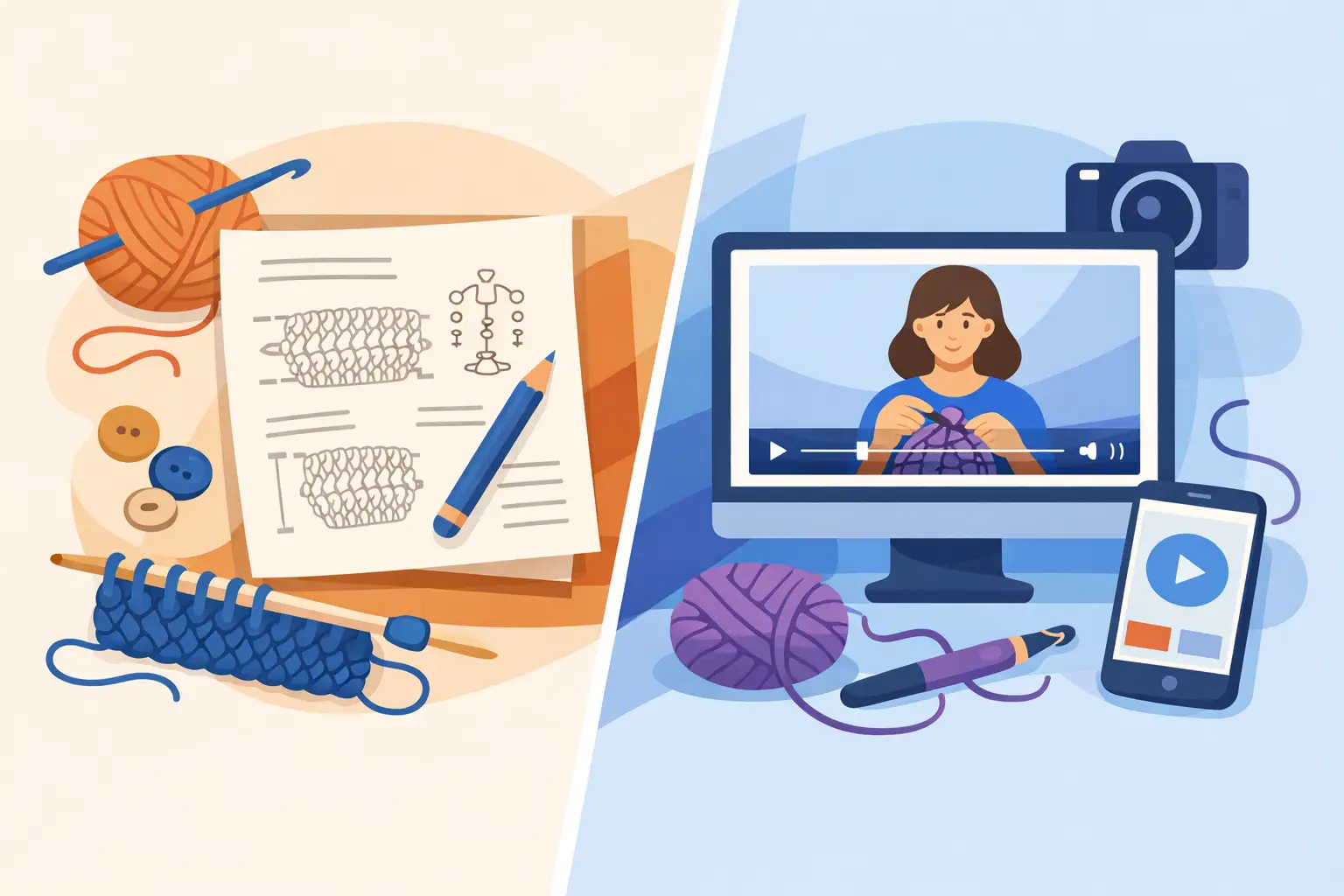
A customer falls in love with your amigurumi, buys the pattern, and wants to start immediately. What happens next depends less on how cute the finished piece looks and more on how clearly you teach the build. In the decision between written patterns versus video tutorials, the strongest choice is rarely about which format is more popular. It is about what helps your customer finish successfully while protecting the time and value behind your design.
For crochet designers selling digital products, written instructions and video are not interchangeable. They create different customer experiences, demand different production workflows, and support different business models. A polished written pattern can become a durable, scalable product. A video can make a difficult technique feel approachable in seconds. Knowing where each one earns its place helps you publish with intention.
Why Written Patterns Still Lead Digital Crochet Sales
A written pattern gives crocheters control. They can work at their own pace, jump to the section they need, mark completed rounds, and return to the instructions days later without hunting through a timeline. For amigurumi in particular, that matters. Projects often include separate pieces, color changes, shaping, assembly, and finishing details that a customer may complete over multiple sessions.
Written patterns are also built for reference. A well-organized PDF lets a maker find the ear placement, review a stitch count, or compare a body round without replaying several minutes of footage. When the pattern includes clear headings, consistent abbreviations, stitch counts, photos or diagrams, and assembly guidance, it becomes a working tool rather than a one-time lesson.
That reference value supports sales. Customers understand what they are buying: a downloadable instruction file they can save, print, annotate, and revisit. For a designer, a written PDF is easier to package as a finished digital product, update when a tester identifies an issue, and maintain as part of a growing pattern catalog.
Written instructions also travel well. They are practical to translate, which opens a path to customers beyond one language market. A video can be subtitled, but translating spoken instruction, on-screen labels, captions, and edits is a much larger production job. If international growth is part of your plan, structure in the written pattern is an advantage from the first draft.
Where Video Tutorials Do the Job Better
Video wins when motion is the instruction. A beginner can read “insert hook through the front loop only” and still hesitate. Seeing the hook enter the stitch resolves that uncertainty quickly. The same is true for invisible decreases, joining legs, sculpting, embroidering facial features, attaching limbs, or managing an unusual color change.
For a design with a signature construction method, a short visual demonstration can reduce support messages and build customer confidence. It can also help your work reach crocheters who learn best by watching rather than reading. That is a real benefit, not a shortcut.
But a video tutorial is not automatically clearer simply because it is visual. Poor camera angles, hands blocking the work, inconsistent lighting, skipped stitch counts, and fast editing can make a video harder to follow than a clean pattern. Video works best when it demonstrates one specific action with a clear view of the yarn, hook, and stitch placement.
Full-length tutorials have another limitation: they are difficult to scan. A customer who needs to confirm Round 37 wants an answer, not a search mission. Even a carefully chaptered video asks the viewer to pause, rewind, and interpret what they are seeing. That is why video is often most effective as support for a written pattern, not a replacement for one. There is also a middle ground the format debate tends to miss: a 3D preview that builds the piece round by round gives a maker the "watch it happen" quality of video, on her own pattern rather than someone else's hands, inside the written format she can still search and annotate.
Written Patterns Versus Video Tutorials: Compare the Work
The decision is also a production decision. Writing a pattern requires disciplined documentation. You need to record every round accurately, check counts, define terms, organize components, prepare images, test the instructions, and revise. That work is substantial, but it creates a reusable asset. Once the pattern is validated and exported, you can sell it repeatedly without needing to be on camera again.
Video has a different cost. You need a filming setup, lighting, audio or captions, a clean workspace, editing time, file storage, and a plan for updates. A 30-minute tutorial can take many hours to record and edit. If you change one shaping round after testing, the correction may require reshooting more than a single clip.
Neither format is effortless. The useful question is which effort matches your product strategy. If your goal is to build a catalog of sale-ready amigurumi patterns, the written version should usually be the core product. If your goal is to teach a specific technique, grow a personality-led audience, or support a more complex release, video may deserve a larger role.
There is also a pricing question. Buyers generally expect a standalone written pattern to be an affordable digital product. A detailed workshop or full video class can support a higher price, especially when it includes instruction that goes beyond one finished design. Yet adding a full tutorial to every pattern does not always increase profit. It can increase your workload faster than it increases perceived value.
Build a Pattern First, Then Add Visual Support
For most independent amigurumi designers, the most sustainable workflow is pattern-first. Write every component. Confirm the stitch counts. Inspect the proportions of the finished character. Send the instructions to testers. Revise the confusing sections. Then export a polished PDF that can stand on its own.
This approach forces useful clarity. If a step cannot be explained in writing, it may need a better photo, a diagram, a clearer construction sequence, or a short video clip. You discover the weak spots before customers do.
A creator-focused workspace such as Amigurumake can make this process more practical by connecting pattern writing with 3D visualization, testing, translation, and export. Instead of treating the pattern as a document you finish at the end, you can use it as the operating system for the product from the first component to the final PDF.
When video is needed, keep it focused. A short clip showing the exact point where a customer may struggle is more useful than an hour of unstructured footage. State what the clip covers, show the stitch or assembly move at a comfortable pace, and direct the customer back to the written round or step. The pattern remains the source of truth. The video removes friction. In Amigurumake this pairing is built in: paste a video link into the pattern's details and it prints on the PDF's materials page as a clickable link, so "pattern first, video as support" ships as one product instead of two files.
Choose Based on Your Customer and Design
A simple, repeatable plush with standard stitches may need only a strong written PDF with clear photos. A pattern aimed at experienced makers can be concise as long as the construction is logical and the details are accurate. These customers often prefer the speed and portability of written instructions.
A beginner-friendly pattern benefits from more visual guidance, but that does not mean you need to film every round. Use close-up images for repeatable steps and reserve video for techniques that are genuinely difficult to communicate in a still image. Define the skill level honestly. A beginner does not need more content for its own sake. They need fewer moments of uncertainty.
Complex character patterns may call for both formats. If a design uses unusual shaping, layered accessories, wire, jointing, or expressive face sculpting, targeted videos can protect the customer experience. They can also make a premium pattern feel more complete. Just make sure the written instructions still allow a customer to finish the project if they cannot or do not want to watch video.
Accessibility matters, too. Some makers cannot comfortably follow video due to hearing, bandwidth, device, or attention constraints. Others find dense text difficult without visual support. Offering both formats where it makes business sense serves more people, but a searchable written pattern is the more reliable baseline.
Your best product does not force customers into your preferred learning style. It gives them enough structure to make progress with confidence. Write the pattern as a professional product, use visuals where they remove real confusion, and let every extra resource earn its place in the workflow.