Amigurumi Market Trends Shaping Pattern Sales
A cute finished plush can earn attention in seconds. A pattern earns trust only when a customer can recreate it without guessing. That distinction sits at the center of current amigurumi market trends: buyers still want charming characters, but they increasingly expect a polished digital product behind every purchase.
For pattern designers, this is good news. Demand is not limited to one aesthetic, one platform, or one type of maker. But the market is becoming more selective. Designs that are easy to understand, easy to gift, easy to personalize, and easy to share have a clearer path to sales than patterns built around novelty alone.
The market is moving from cute to collectible
Amigurumi has always been visual. A tiny animal with expressive eyes, a food character with a face, or a fantasy creature with an oversized head can stop a scroll quickly. What is changing is the buyer's reason for purchasing. Many customers are building collections, making gifts for specific people, or looking for a project that feels like a finished object worth keeping.
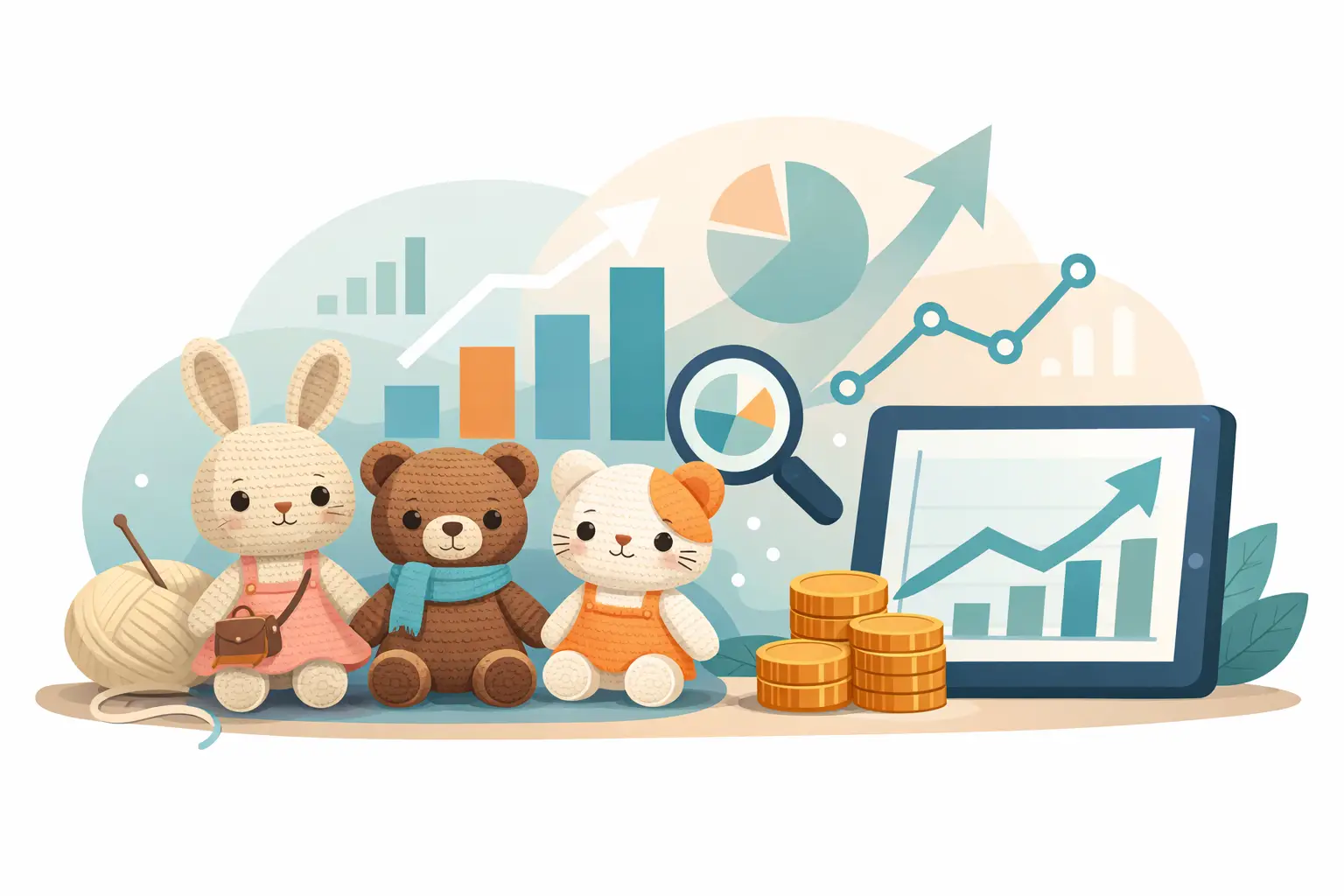
Amigurumake's Trend Radar tracks what the amigurumi market is actually searching for, refreshed daily from live marketplace data. As of mid-August 2026, the most popular creatures are the Highland Cow and the Cat (tied at a 95 popularity score), followed by the Bunny (92), the Chick (91) and the Corgi (90), with the Chick growing fastest at +16%. Among themes, Kawaii still leads at 96, but the fastest movers are Kawaii Cyber (+19%) and Emotional Support Gifts (+20%). That last one says something about why people buy: not just characters to collect, but comfort to give. The full radar, with palettes, produce and mash-ups, is inside the studio, free with an account.
That favors designers who think in product lines rather than isolated releases. A single frog may sell. A frog with seasonal outfits, color variations, accessory packs, and companion characters gives customers a reason to return. The strongest collections have a recognizable visual language while leaving room for new releases.
This does not mean every designer needs to create a massive universe. Small, focused collections can work especially well. Three related sea creatures, a set of graduation animals, or a series of pocket-sized fruits can create a stronger storefront than a mix of unrelated one-off patterns.
The trade-off is creative repetition. Collections require consistency in proportions, construction, photography, and instruction style. Build a reusable design system for your own work: decide how you handle limbs, eye placement, color changes, embroidery, and assembly. That makes each new pattern faster to write and easier for customers to recognize.
Amigurumi market trends favor clear instructions
As more people buy digital patterns, clarity has become a competitive feature. Customers compare more than the finished sample. They notice page layout, material lists, abbreviation guides, progress images, assembly order, and whether the pattern anticipates common mistakes.
A pattern that looks beautiful but leaves unclear attachment points can create support requests, poor reviews, and abandoned projects. A pattern that guides the maker through difficult moments builds confidence and makes future purchases more likely.
Visual validation matters before publication. Designers often understand a shape because they invented it. A customer sees only the stitches on the page. Inspecting each component before exporting helps catch issues such as a missing increase, an uneven body section, or a piece that comes out flatter or wider than the design intended.
Testers remain essential, but they should validate a pattern rather than rescue it. Send testers a draft that already has a logical structure, complete stitch counts, and clearly marked assembly steps. Ask focused questions: Where did you pause? Which sections needed a photo? Did the finished proportions match the sample? Specific feedback produces usable revisions.
Make the PDF feel like a finished product
A sale-ready PDF does not need decorative clutter. It needs hierarchy. Let the project photo introduce the design, then make supplies, gauge guidance, abbreviations, and instructions easy to scan. Use consistent naming for pieces. If a leg is called “Leg 1” at the start, do not switch to “first leg” halfway through.
Photos and diagrams should solve a problem, not simply fill space. Use them for shaping, color transitions, facial placement, joining pieces, and any technique likely to be unfamiliar to the intended skill level. If a beginner could misread it, show it.
Personalized projects are gaining ground
Many buyers are not crocheting for themselves. They are making birthday gifts, nursery decor, teacher presents, memorial keepsakes, wedding favors, or holiday surprises. That creates demand for patterns that can be customized without requiring the customer to redesign the project.
Offer options where they make sense: alternate colors, removable clothing, different facial expressions, letter details, or a choice of accessory. A base doll pattern with a few hairstyle and outfit variations may have broader appeal than a highly specific character that can only be made one way.
The key is to avoid turning flexibility into confusion. Clearly separate required instructions from optional versions. If color changes are optional, say so. If a customization changes the amount of yarn needed, include that information. Customers appreciate choice, but they need boundaries that keep the project manageable.
Seasonal releases also benefit from personalization. Rather than chasing every holiday with a completely new design, adapt a proven base structure. A familiar animal can become a valentine, graduate, pumpkin, or winter gift through accessories. This approach reduces development time while giving your catalog timely reasons to surface again.
Global customers raise the bar for localization
Digital patterns can travel immediately, and amigurumi customers often search across borders for styles they cannot find locally. Translation can expand a pattern's reach, but it is not a simple word-for-word task. Crochet terminology, yarn references, decimal conventions, and abbreviations can vary by language and region.
Start with a clean source pattern. Define every abbreviation, use complete stitch counts, and avoid casual wording that depends on cultural context. The more structured your original pattern is, the easier it is to translate, proof, update, and maintain.
Localization is most valuable for patterns that have already shown demand or have broad visual appeal. You do not need to translate every release on day one. Test your strongest products first, then build language coverage around real customer interest and your capacity to support those editions.
A translated pattern should feel intentional. That means checking terminology with a crochet-aware reviewer when possible and making sure the PDF layout still works once words become longer or stitch terms change. International growth is an opportunity, but accuracy protects the reputation you worked to build.
Pricing is becoming a positioning decision
Low prices can attract impulse buyers, but they can also signal that a pattern is disposable. Higher prices can support a more developed product, especially when the pattern includes multiple variations, detailed visuals, tester validation, or a coordinated collection. Neither approach works automatically.
Price according to the value and complexity of the digital product, not just the number of pages. Consider the design's originality, the time saved for the customer, the level of instruction, the number of included options, and the support burden it may create. A quick accessory pattern and a fully articulated doll pattern should not be treated as identical products.
Bundles are useful when they create a genuine project advantage. A set of related animals, outfits, or seasonal accessories can make the customer feel they are getting a cohesive creative experience. Avoid bundling unrelated older patterns just to create a larger number. Buyers can tell the difference between a collection and a clearance bin.
Build a workflow that can keep up
The most durable shift in the market is operational. Successful pattern designers are not only making more. They are reducing the friction between idea, sample, written instructions, testing, revision, export, and sale.
A scattered workflow can slow every release. Notes live in one document, photos in another folder, stitch counts in a notebook, tester edits in messages, and translations in separate files. That may work for a first pattern. It becomes expensive as a catalog grows.
Treat each design as a repeatable production process. Write the pattern while the sample is fresh. See the construction before finalizing instructions. Organize tester feedback in one revision pass. Export a consistent PDF. Then keep the source organized so you can update it, translate it, or create a variation later.
Amigurumake is built around that creator workflow: write the pattern, watch each piece build in 3D, put the pieces together to check the proportions, prepare polished exports, and manage the details that turn a crochet design into a sellable digital product.
What to watch next
Expect continued demand for expressive, giftable, small-to-medium projects that fit into busy makers' schedules. Customers want satisfying results, but many also want projects they can finish before an event, a holiday, or a birthday. Clear skill labels and realistic time expectations can help the right buyer choose your pattern.
At the same time, original design identity will matter more. Trend-inspired ideas can bring visibility, but a catalog built only around fast-moving aesthetics is difficult to sustain. Your proportions, faces, construction choices, and storytelling are assets. Develop them deliberately.
The best response to the market is not to publish faster at any cost. Publish with enough structure that every new pattern can become a dependable part of your catalog. Make the project easy to understand, make the product easy to trust, and give customers a reason to come back for the next character you create.