Why Crochet Patterns Confuse Buyers and Cost Sales
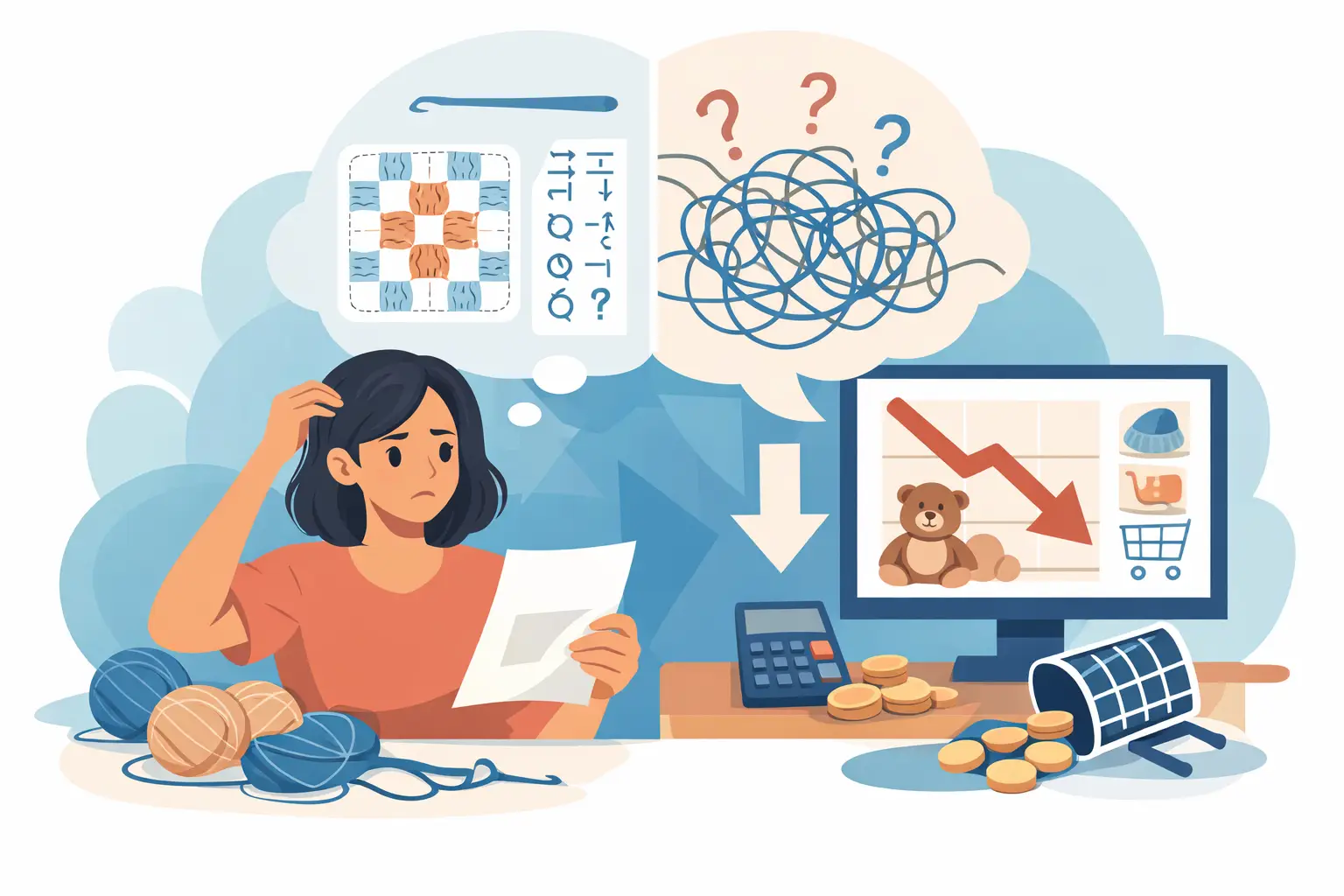
A buyer reaches Round 18, cannot tell which stitch belongs in the next decrease, and sets the project aside. The pattern may be technically correct. But the customer does not experience it as correct. They experience it as confusing. That gap is why crochet patterns confuse buyers, create support messages, and turn a promising sale into a refund request or a quiet one-star review.
For amigurumi designers, clarity is not a cosmetic extra added after the design is finished. It is part of the product. Your customer is purchasing a repeatable path from yarn to finished character. If that path requires too much guessing, the buyer has to do the work your pattern should have done for them.
Why Crochet Patterns Confuse Buyers
Most confusion begins with invisible context. As the designer, you can see the finished animal, doll, or creature in your hands. You remember where the limbs sit, how tightly the head was stuffed, and why a certain round needs a color change. Your buyer sees a PDF, a materials list, and a starting point.
They do not have your memory of the prototype. They do not know whether the ears should fold before sewing, whether the marker stays at the center back, or how much the body shape changes after stuffing. When instructions assume that shared knowledge, buyers are forced to interpret instead of crochet.
This is especially common in patterns written from notes made during the design process. Notes are useful for the person who made the original sample. A sellable pattern must work for someone who has never seen your worktable, never used your preferred yarn, and may read crochet instructions differently than you do.
Buyers Are Purchasing Certainty, Not Just Instructions
A pattern buyer understands that crochet takes skill. They do not expect every project to be effortless. What they expect is confidence that each step is intentional, complete, and possible to verify.
That is why a pattern can include every round count and still disappoint customers. The numbers may be present, but the decision-making burden remains. A buyer may know to make six single crochets in a magic ring, yet still wonder whether the next component is worked in continuous rounds, turned rows, or joined rounds. They may complete the piece and have no clear cue that its proportions look right.
The more collectible or character-driven the design, the higher the need for certainty. Amigurumi buyers care about expression, symmetry, positioning, and finish. A two-stitch difference in an eye placement row can change the entire face. Telling someone to attach the eyes between Rounds 12 and 13 is not always enough. They may need to know the number of stitches between the eyes, the front-facing reference point, and what to check before locking the washers in place.
Shorthand becomes a barrier when it is inconsistent
Abbreviations save space, but only when they are predictable. A buyer should not have to decide whether inc means two single crochets in one stitch, an increase of any stitch type, or a named increase technique. The same applies to terms like dec, BLO, FLO, sl st, and sc.
Define the terms you use, then use them exactly the same way throughout the pattern. Avoid switching between written phrases and abbreviations without a reason. If a special technique matters to the final shape, explain what it is meant to achieve, not only how to execute it.
US and UK terminology creates another frequent problem. A buyer working from US terms can produce an oversized, misshapen project if the pattern quietly uses UK stitch names. State the terminology near the beginning, where it cannot be missed. This tiny detail prevents a major failure.
Construction logic is often missing
Many instructions tell buyers what to make but not how the pieces relate to one another. A list of head, body, arms, legs, ears, and tail is not an assembly plan.
Buyers need to know whether to stuff as they go, leave a long tail, flatten a piece before sewing, or shape it with extra stitches. They need attachment points that are measurable and repeatable. A phrase such as sew the arms to the sides may be obvious to the designer, but it leaves too much room for variation when the arms determine the character's posture.
Use clear reference points. Name the rounds, count the stitches between components, identify front and back, and explain the intended angle. When positioning depends on the finished look, include a visual checkpoint before the buyer commits to sewing.
Photos can decorate instead of explain
Beautiful cover photography sells the idea of a pattern. Process visuals sell the experience of completing it. These serve different jobs.
A styled image of a finished fox does not solve a buyer's question about where to insert the hook for an uneven decrease or how to align a muzzle. Photos are most valuable at high-risk moments: starting an unusual component, changing direction, adding facial features, assembling pieces, and finishing details.
Images also need labels. If a photo appears after an assembly instruction, tell the buyer what they should notice. Is it the stitch count, the angle, the row alignment, or the placement relative to another part? Without that cue, buyers can look directly at the answer and still miss it.
A Pattern Can Be Correct and Still Be Hard to Use
Technical accuracy is the floor, not the finish line, though it is a floor that AI-generated patterns still fall through. A pattern may have perfect stitch math yet be difficult to follow because information arrives too late, repeats are hard to scan, or important exceptions are buried in dense paragraphs.
Think about the buyer's hands while they work. They may be checking instructions on a phone, tracking their round with a marker, and pausing between sessions. A large block of text is harder to recover from than a well-spaced sequence with clear round labels and repeat instructions. A long pattern does not need to feel complicated, but it does need to be navigable.
Skill level labels can create confusion too. Calling a pattern beginner-friendly raises a specific promise. If the project requires invisible decreases, wire armatures, advanced shaping, color changes, or precision sewing, say so. That does not shrink your market. It helps the right buyers say yes and gives motivated learners a realistic view of what they will practice.
Yarn substitution is another place where precision matters. If your sample uses plush yarn, cotton yarn, or a specific hook size to achieve a certain scale, explain what may change when the buyer substitutes materials. Gauge is not always the central concern in amigurumi, but fabric density, safety-eye fit, and finished proportions often are.
Write for the Moment a Buyer Gets Stuck
The strongest pattern workflow anticipates hesitation before a customer finds it. Start by separating design notes from customer instructions. Your notes can be fast, abbreviated, and personal. The pattern should be organized around the buyer's sequence of decisions.
First, make the materials section practical. Include yarn amount or weight when available, hook size, safety-eye size, stuffing, notions, and any optional tools. If a material affects the final result, explain why it was selected. Buyers can make informed substitutions when they understand the trade-off.
Next, structure every component so it can stand on its own. Give it a clear name, state whether it is worked in continuous rounds or rows, identify color changes at the exact point they occur, and make stitch totals easy to check. A count at the end of a round is a quality-control tool, not filler, and a free pattern checker will confirm every one of them in seconds.
Then add checkpoints where shape or placement matters. A checkpoint might tell the buyer that the piece should resemble a shallow cup after Round 8, that the opening should face inward during assembly, or that both legs should match before attaching them. These small confirmations reduce the fear of continuing with a mistake.
Finally, treat finishing as its own stage. Assembly, embroidery, stuffing, weaving in ends, and posing can determine whether a project looks polished. Give these stages enough space. Buyers remember the final look more than they remember how quickly the body was crocheted.
Validate Before You Publish
Testing reveals the difference between what a designer intended and what a buyer receives. Ask testers to report more than errors. Find out where they paused, reread a sentence, questioned placement, or changed a step because it felt unclear. Those moments identify friction in the product experience.
Tester feedback is most useful when you can compare it against the exact instruction, image, and component shape involved. If several testers ask the same question, the issue is not that they failed to read carefully. The pattern needs a stronger cue.
Visual validation helps before testing even begins. When you can watch each component build in 3D as you write its rounds, you catch shape and proportion problems before they become expensive revisions. Amigurumake brings writing and visual inspection into the same workflow, so each piece can be checked as it is written and the pieces can be put together on screen, rather than after a tester has spent an evening on it.
Translation deserves the same validation standard. Direct word-for-word conversion can lose stitch meaning, regional terminology, or the tone of an instruction. If you sell internationally, each language version should preserve the same counts, construction logic, and visual references. A translation that reads naturally but changes a technical instruction is not ready to sell.
Turn Clarity Into a Business Advantage
Clear patterns reduce support time, protect reviews, and make buyers more likely to trust your next release. They also support stronger pricing. Customers recognize the difference between a document that lists rows and a professional digital product that guides them from first stitch to finished character.
That does not mean every pattern needs dozens of photos or pages of explanation. The right level of detail depends on the design, the promised skill level, and the complexity of its construction. A simple ball-shaped accessory may need very little guidance. A poseable doll with clothing, hair, colorwork, and sculpted features needs more structure.
Write with the buyer's uncertainty in mind, then remove it one decision at a time. When customers can see where they are, confirm what is correct, and recover easily after a break, they are free to enjoy the part they came for: bringing your original character to life.